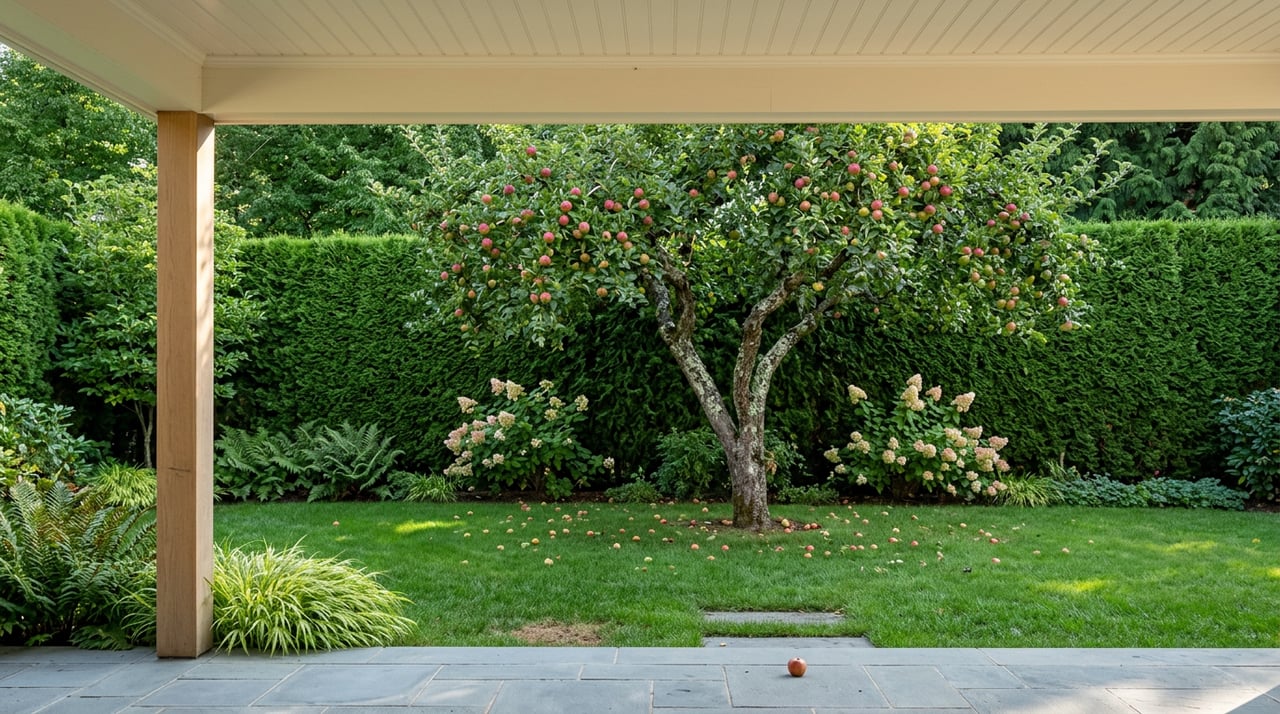
The Late-Summer Hush at Piper's Orchard, Before Broadview's Fall Calendar Fills Up
August 6, 2026
August 6, 2026
Walk down the ravine from the Eddie McAbee entrance behind the QFC on Holman Road any weekday in August, and you can usually hear the orchard before you see it. Wasps working windfalls. A woodpecker somewhere upslope. The occasional thump of a Gravenstein giving up on its branch. This is the quiet half of the Carkeek Park calendar, the six or seven weeks when the heritage trees on the eastern slope of the Piper's Creek Trail are doing the most interesting thing they do all year, and almost nobody is watching.
By November the trail will be busy. Blue-vested Salmon Stewards from the Carkeek Watershed Community Action Project station themselves along the creek every Saturday and Sunday to explain what the chum are doing in the water, and last fall CWCAP volunteers counted more than 1,500 live chum in Piper's Creek in a single day, more than the total recorded during any entire spawning season since counts began in 1987. The apples get none of that attention, which is exactly why late summer is the best time to be up on the bench above the creek.
Most Broadview residents drive to Carkeek's lower lot for the beach and the bridge over the BNSF tracks, then never see the orchard. The orchard sits above the creek, roughly halfway between the Carkeek Park Road entrance and the McAbee trailhead, and the McAbee side is the shorter approach. The parking lot and trailhead are tucked behind the QFC, off NW 100th Pl at 6th Ave NW, and Metro's 28, 40, and D Line all stop within a short walk. From McAbee the trail drops through the ravine and meets Piper's Creek Trail; the orchard climbs the eastern slope on your right.
The bench itself was homestead ground. Andrew W. Piper, a baker, confectioner, cartoonist, and Seattle City Council member, moved his family to logged-off cabins on this site after the Great Seattle Fire of 1889 burned down his bakery. His wife Minna ran the gardens and hauled produce to city markets by wagon; Andrew baked the apples and pears into pies. Their heirs sold to Morgan J. Carkeek, who donated the land to the city, and in 1929 this stretch of the Piper's Creek watershed became Carkeek Park. The orchard was forgotten under blackberry and alder for roughly half a century.
In 1981, landscape architect Daphne Lewis was surveying the park for a master plan when she noticed an apple tree standing at attention in the underbrush. She and a small crew from what became the Friends of Piper's Orchard spent the next two years clearing trails and cutting back the overgrowth. When they were finished, they had exposed 32 original trees planted on a 20-foot grid and identified roughly 30 heirloom fruit varieties on 1.5 cleared acres. Most were apples that had been commercially available in Seattle by 1890.
If you visit between now and early October, you're looking at some or all of these on the trees:
Fruit picked by hand and eaten in the orchard is fair game. The bulk of the harvest is bagged by volunteers and donated to local food banks, with a portion pressed for cider at the annual festival. If you carry apples out by the bagful, you're taking them away from the food-bank drop, which is a small thing but worth knowing.
The orchard is not self-maintaining. Friends of Piper's Orchard runs work parties most months on the third Saturday, and the tasks scale with the season: pruning in winter, bagging young fruit against apple maggot in spring, mulching and clearing windfalls in summer and early fall. FoPO coordinates with Seattle Parks and Recreation's Urban Food Systems Program, City Fruit, the Carkeek Park Advisory Council, and the Seattle Tree Fruit Society. If you've lived on the ridge for years and never crossed paths with any of them, a third-Saturday work party is a low-commitment way to meet neighbors who know more about Northern Spy than anyone should reasonably know.
"It's everybody's dream that it'll be a self-sustaining run again."
That's Mary Vincent, a longtime Carkeek Salmon Steward, talking about the fish, but the same sentence applies upslope. The orchard doesn't propagate itself either. The trees standing today are a mix of Piper originals still bearing after 130-plus seasons and replacement grafts the Friends have added since the 1980s.
The 16th annual Festival of Fruit falls on Saturday, October 4, 2026, from 11 a.m. to 2 p.m., staged at the orchard itself and at the nearby Environmental Learning Center. It's free. The rough shape of the day, based on the last several festivals:
Parking at Carkeek is genuinely limited on festival day. The lot at the lower meadow fills before 11, and the road down is narrow. The Friends' standing recommendation is to walk in from the McAbee side, park up on 3rd NW near the school, or take the bus. This is one of those events where the walk is part of the experience rather than a hardship.
The Broadview fall arc is really two events using the same trail. The orchard peaks between the Gravenstein drop in mid-August and the Festival of Fruit on October 4. Then, roughly three weeks later, the chum and coho begin pushing up Piper's Creek from Puget Sound, generally starting in late October and running through early December. Salmon Stewards in blue vests set up at an interactive booth near the east end of the lower meadow parking area every Saturday and Sunday in November, and the annual Salmon Celebration Day anchors the middle of that month.
The best viewing spot on the creek is unromantic and worth knowing: Piper's Creek disappears into more than 300 feet of concrete culvert at a fish barrier, and returning chum stack up at the base of that pipe trying to push further upstream. That's where Salmon Stewards concentrate, because that's where the fish concentrate. Standing there in November, then thinking back to standing under a Wolf River tree twenty vertical feet upslope in September, is the shortest crash course in what a restored urban watershed actually looks like.
August in Broadview tends to run slower than the rest of the year anyway. Bitter Lake Community Center closes for annual maintenance August 22 through 30, so kids' programming shifts elsewhere for that week. If you want somewhere to land after an orchard walk, Broadview Tap House at 217 N 125th St keeps 30 taps and is open every day, with a rotating food-truck lineup that most residents already know by heart.
None of this shows up on the neighborhood's real estate profile, which is roughly the point. What makes Broadview Broadview is a 216-acre park with a heritage orchard, a restored salmon stream, a beach on Puget Sound, and a small group of volunteers who have been pruning the same trees for four decades. Most weekends, most of it is empty.
If you're weighing a move within Seattle or thinking about what your own Broadview home will look like against the market this fall, I'd rather talk about it after you've walked the trail than before. Let's connect when you're ready, and in the meantime, Gravensteins are dropping. — Brooke Davis Real Estate

Her passion is helping clients achieve their homeownership goals, from a home seller looking to upgrade or relocate to a first-time buyer and a seasoned investor looking to build their financial portfolio. Brooke will guide and advocate for you through the entire process from beginning to end. Contact her today!