Why the Phinney Ridge Premium Changes Size Depending on Who's Counting
September 24, 2026
September 24, 2026
Open two tabs on the same afternoon, one showing Phinney Ridge and one showing Greenwood, and you'll get two different answers to the same question: how much more does it cost to live two blocks south of the line at N 67th Street. One tab might tell you the gap is a manageable $150,000. Another will show something closer to half a million dollars. Neither tab is lying. They're just measuring different things, and if you're actually trying to decide between the two neighborhoods this fall, that difference matters more than either number alone.
This isn't a case of bad data. It's a case of three legitimate methods producing three legitimate, and very different, answers. Understanding which one applies to your situation is the actual work of comparing these two neighborhoods, and it's the part most quick searches skip.
Here's what the current data actually shows, side by side, with the method behind each figure:
| Measure | Phinney Ridge | Greenwood | What it's really comparing |
|---|---|---|---|
| Median sale price | $1.4M (March 2026) | $941K (as of July 2026, most recent NWMLS reporting) | Whatever mix of homes happened to close, blended together |
| Average sale price | $1.28M | roughly $889K in recent monthly data | Same blending problem, different math |
| Days on market | 6 days | 7 days | Nearly identical demand pace |
| Median $/sqft | $625, up 3.4% year over year | Not consistently reported at the neighborhood level | Size-adjusted value, when available |
Run the straight median-to-median math and the gap is about $459,000. That's a real number, pulled from the most current sale data each neighborhood has, and it's the number you'll see if you just look up both places on any major site.
But a separate rolling 12-month analysis that matched houses by size, condition, and lot rather than by neighborhood boundary found something different: a premium of $125,000 to $200,000 for Phinney Ridge over comparable homes in nearby North Seattle areas broadly, not Greenwood specifically. That analysis also found something worth sitting with. The gap didn't creep up gradually. It jumped in 2025, then both Phinney and its neighbors kept appreciating at roughly the same pace after that. In other words, the premium reset once and has mostly held steady since, rather than continuing to widen every year.
So which number is right? Both are, depending on what you're actually buying. The half-million-dollar gap describes what happens when you compare the full mix of homes sold in each area. The smaller gap describes what happens when you compare a similar house to a similar house. If you're shopping for a specific size and condition of home, the second number is closer to your reality. If you're just trying to understand why the neighborhood-wide headlines look so different, the first number explains that.
Neighborhood medians are usually less clean than they sound. In Phinney Ridge and Greenwood specifically, a few things get folded into that single number that pull it in different directions.
The upshot is that Greenwood isn't uniformly cheaper than Phinney Ridge. It has a wider spread, with a meaningful cluster of homes priced the same as what you'd find a few blocks north. The median just doesn't show you that spread.
Here's the part that's easy to lose in spreadsheets: this isn't an abstract comparison between two zip codes. It's a specific street. Phinney Avenue North runs the spine of Phinney Ridge and becomes Greenwood Avenue North the moment you cross N 67th Street. You could stand at that intersection and be looking at both markets at once.
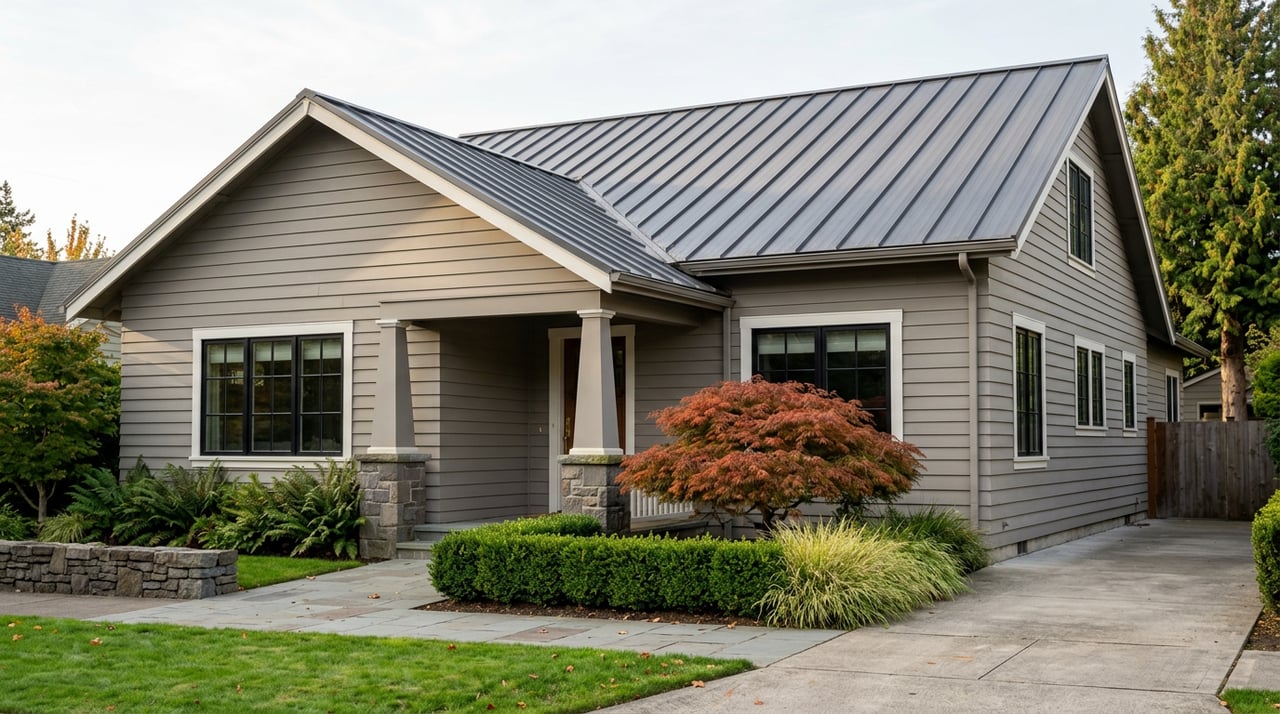
On the Phinney side of that line, the housing stock leans toward early-1900s Craftsman bungalows and Seattle box houses, largely intact from the neighborhood's original platting above Woodland Park. On the Greenwood side, you're looking at a similar era, 1920s through 1940s Craftsman bungalows and Tudor cottages, but with more recent townhome and small-condo infill mixed in on standard-sized lots.
The bones are genuinely comparable. The difference shows up in what's been built around the older stock and how much of the newer, lower-priced inventory gets counted into each area's median.
If you take the matched-house premium, the $125,000 to $200,000 figure, as the more useful number for comparing similar properties, here's what that actually represents. It's the cost of being on the Phinney side of N 67th rather than the Greenwood side, holding size, condition, and lot type constant. That premium buys proximity to the original PhinneyWood commercial spine, walkability to Woodland Park and the zoo, and the specific character of streets platted more than a century ago for the neighborhood Guy Phinney's estate became.
If you're instead looking at the full $459,000 median-to-median gap, you're seeing something closer to market composition than location value. Part of that number reflects Greenwood's larger share of newer, smaller, or less-renovated inventory pulling its median lower, not a straight per-square-foot cost of crossing the street.
Neither framing is wrong. But if a seller, a listing agent, or a market snapshot only ever quotes you the bigger number, ask what's included in each side of that comparison before you treat it as the true cost of one neighborhood over the other.
One number in the table above deserves more attention than it usually gets: days on market. Phinney Ridge homes are selling in about 6 days as of March 2026 data. Greenwood homes are selling in about 7. That's close enough to call it the same pace.
This matters because it tells you the price gap isn't a demand story. If Phinney Ridge buyers were racing toward it and Greenwood buyers were sitting on the sidelines, you'd expect a much bigger gap in how fast homes move. Instead, both markets are moving at nearly identical speed, which suggests the price difference is baked into the housing stock and lot inventory itself, not into how urgently people want one address over the other.
City-wide, the picture has shifted meaningfully this fall. Seattle entered September 2026 with 4.3 months of resale inventory, the first time the market has crossed above four months of supply since early 2012, and mortgage rates have been sitting close to 7 percent. That gives buyers comparing Phinney Ridge and Greenwood more room to be selective than they've had in years, even in two markets that are still each moving in about a week.
If you're deciding between these neighborhoods, the practical move is to stop comparing medians altogether and start comparing the specific homes you'd actually consider buying in each. Pull recent sold data for a matched size, age, and condition on both sides of N 67th Street, not the neighborhood-wide average. Ask whether the listing you're looking at falls into Greenwood's upper tier, where prices already overlap with Phinney, or its lower tier, where the newer infill and smaller lots live. And weigh the lifestyle premium honestly: if daily walkability to the Phinney business district and quick access to Woodland Park matter to how you'll actually live day to day, that's worth pricing in separately from the raw dollar gap.
Is Greenwood cheaper because of condos and townhomes dragging the median down? Partly. Greenwood's mix includes more recent townhome and small-condo infill than Phinney Ridge, and that inventory sits below the neighborhood's Craftsman and Tudor stock in price, which pulls the overall median lower even as top-tier homes in Greenwood price similarly to Phinney.
Does a widening price gap mean Phinney Ridge is overpriced right now? The available data suggests the gap reset once, in 2025, and has since moved in parallel with nearby areas rather than continuing to widen every year. That pattern looks more like a one-time repricing than an ongoing trend, though real estate rarely moves in a straight line.
Which number should I actually trust when I'm comparing the two neighborhoods? Whichever one matches your comparison. If you're sizing up a specific home against a specific home, use a matched-house comparison, not the neighborhood-wide median. The median is useful for spotting a trend, not for pricing an individual purchase.
If you're trying to figure out what a specific home in either neighborhood is actually worth, or what a matched comparison would look like for your situation, that's exactly the kind of question worth working through with someone who watches both sides of N 67th Street closely. Brooke Davis has spent two decades in Seattle's neighborhood-level market data and can walk you through what the numbers mean for your specific search. Let's Connect.


Her passion is helping clients achieve their homeownership goals, from a home seller looking to upgrade or relocate to a first-time buyer and a seasoned investor looking to build their financial portfolio. Brooke will guide and advocate for you through the entire process from beginning to end. Contact her today!