The Nine Acres Broadview Almost Paved Over
August 27, 2026
August 27, 2026
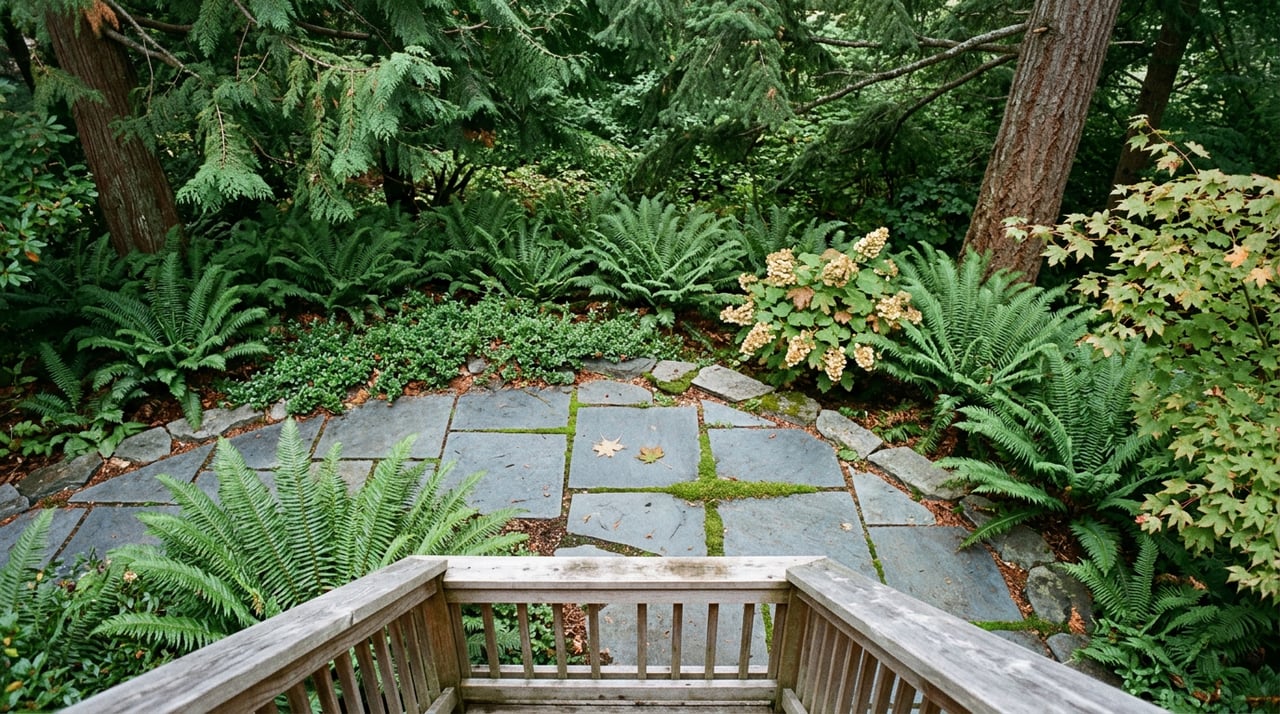
If you've driven past the corner of 3rd Avenue Northwest and 145th, you've probably registered the gravel lot and the two concrete pillars and kept going. There's no sign that announces anything worth stopping for. One Yelp reviewer described the entrance as easy to overlook, just a park sign and some old concrete pillars next to a gravel lot. That's a fair read of the surface. It's also the reason most people in Broadview have never actually walked the woods behind it.
What sits behind those pillars is Llandover Woods Greenspace, a nine-acre pocket of second-growth forest tucked into a ravine at the northwest edge of the neighborhood. The trail loop is short, under a mile, and the elevation gain is modest enough that trail-tracking sites like AllTrails file it under easy. None of that explains why it matters. What matters is what almost happened here instead, and the fact that the ground under your feet on that loop used to be somebody's future driveway.
In the early 1990s, a developer called Shorewoods LLC had plans for this exact parcel. The first version called for 23 homes. A later version scaled it back to nine. Either way, the mechanics of a subdivision were already in motion: roadbeds were graded, lots were surveyed, soil samples were taken, and addresses were assigned. The plan even called for extending Northwest 145th Street westward, which would have cut the greenbelt off from the forest to the south and erased the informal trail that neighbors had been using for years.
None of those houses got built. In June 1995, after what public records describe as extensive negotiation, the City of Seattle purchased seven of the nine platted lots, roughly 9.5 acres, for $1.475 million, using funds from a 1989 Natural Areas Bond Issue. The city's own reasoning at the time was blunt: open space was scarce in the northwest part of the city, and this was one of the last patches of anything close to intact. Two lots with direct frontage on 3rd Avenue Northwest were left out of the purchase and eventually became houses, which is part of why the trailhead still looks residential rather than park-like.
The graded roadbeds didn't disappear when the sale closed. Early volunteer trail work in the mid-1990s ran directly on top of them, which is part of why the main loop through Llandover Woods still feels more like a lane than a footpath in places. You're not walking a trail that was cut for hikers. You're walking a street that was cut for houses and then handed back to the trees.
Buying the land was the easy part. Keeping a nine-acre ravine walkable took ongoing labor, and that labor has a name: the Friends of Llandover Woods, a volunteer group established in 2005 that held monthly work parties in the years that followed, focused mostly on clearing invasive species and stabilizing the trail. Glenn Austin, the group's lead steward in those early years, spent time documenting the birds that moved through the canopy, and his species list was compiled as a reference for the wider watershed, including the nearby Carkeek Park Education Center.
The Boy Scouts of America built the wooden stairs near the southwest corner of the property, still the steepest stretch of the loop. A landslide in the winter of 1995-96 tore through the top of the trail and spilled sand and rock all the way down to Sherwood Road, and surveys afterward found the head of that slide still undercut. None of this is dramatic in the way a ribbon-cutting or a grand opening is dramatic. It's the slower, less photogenic kind of neighborhood maintenance that keeps a place usable without anyone outside the immediate group ever hearing about it.
The loop itself runs about 0.9 miles with roughly 173 feet of elevation change, gravel-surfaced and well-marked at the junctions. There are two ways in. The main one is the small lot at 3rd Avenue Northwest and 145th, which trail reports describe as rarely filling up even on weekends. The second is a quieter approach off Sherwood Road Northwest on the south side, which connects to the same loop if you're coming from that direction instead.
Once you're inside, the character changes fast. The canopy is a mix of deciduous and evergreen trees, dense enough that Seattle's own parks page describes the interior as often so quiet you can hear a leaf drop. The forest floor is thick with ferns, enough that more than one visitor has joked about wondering what's feeding them. One section of trail opens onto a narrow view across the ravine toward the Olympic range, and hikers who continue toward the Sherwood Road side sometimes catch a glimpse of Puget Sound through the trees near the end of the loop. Dogs are welcome on leash, and the trail sees a steady mix of birders, joggers, and people just looking for twenty quiet minutes between errands.
None of this required construction or a large budget. It required the 1995 purchase holding, and a small volunteer group willing to spend years on unglamorous upkeep so the canopy stayed healthy and invasive blackberry didn't retake the loop.
Part of the reason Llandover Woods stays under the radar is geography. It sits right against the Shoreline city line, at the far northwest corner of Broadview, away from the corridors most people associate with the neighborhood, like Greenwood Avenue or Aurora. Part of it is the entrance itself, which still reads as residential rather than civic. And part of it, honestly, is that nine acres is small. It doesn't compete for attention with Carkeek Park's six miles of trail and its beach access, and it was never built or marketed as a destination the way a bigger park would be.
But that's also the point. A 2009 feature in the Seattle Times, written for people considering a move to the neighborhood, called Llandover Woods one of Broadview's best-kept secrets, and nothing about the geography has changed since then that would make that description less true. The trail is the same length. The stairs the Boy Scouts built are still there. What's changed is that another generation of Broadview residents has moved in without ever hearing the story of what this particular nine acres almost became.
If you've lived in Broadview for years and have never actually parked at that gravel lot, you're not missing an amenity. You're missing a piece of the neighborhood's own history, sitting quietly under a canopy that was almost cleared for good.
If you're curious about other corners of Broadview that don't show up on the usual lists, or if you're thinking about what your own move in or around this neighborhood might look like, Brooke Davis knows the streets here well beyond the market data. Let's Connect.

Her passion is helping clients achieve their homeownership goals, from a home seller looking to upgrade or relocate to a first-time buyer and a seasoned investor looking to build their financial portfolio. Brooke will guide and advocate for you through the entire process from beginning to end. Contact her today!